Wednesday, April 6, 2011

IMAGES OF TWO GREAT BLUE HERON'S NEST WITH CHICKS!

On the second day, as I started photographing, all the action was in the first or lower nest. No chicks could be seen in the second (higher) nest and the great blue was not in the nest but higher up on the treetop, seemingly sunning itself in the warm Florida light.


As I was concentrating on the lower nest, something caught my eye. There was movement in the higher nest. I quickly scanned with my lens to see a chick sticking its head up and screeching for its parent, looking up and down in search of the parent that would feed it.


As it looked up, it spotted its parent and started really screeching and another chick could then be seen.


It was exciting trying to keep my lens focused on the chicks while keeping one eye on the parent, trying to see what the parent would do. I saw it look down at the chick and I quickly refocused up to the parent. Then catching it as it flew down to its nest and children, I refocused now on the nest to see the interaction. As soon as it landed, the babies started reaching up to be fed.


To those of you who read yesterday's post, the parents feed the children by sticking their bills down the chicks' throats and regurgitating partially digested frogs, fish ect. You can see the chick grabbing at the parent's bill looking for food. Throughout the time I observed them, (about one and a half hours), the adults seemed more interested in grooming than feeding. I only saw one instance of the parent actually feeding the chick the entire time I was there (see image below). Now they may have fed the chicks before I arrived and then left the nest while the young rested. But as I saw and heard, the young wanted more food.


                This shows the only time I saw what appeared to be the parent feeding one of the chicks.


                                   A parent's grooming time and the chicks could not compete.


As you can see in these images, one chick was much more aggressive then the other at trying to get food. This makes me wonder about the future of the second chick. The strongest chicks will get more food and  will survive, the weaker will not. If there is not enough food, the stronger chick will push the weaker out of the nest to its death. Not a lot of family values in the heron community, I guess, just survival. Although when I was a child, I was the oldest of six boys and you should have seen our dinner table. Lots of survival mode exhibited there, especially when there was one last meatball to be eaten!


Interesting Facts about the Great Blue Heron:

  • Hollow bones: Yes, these birds have hollow bones, which is how such a big bird is light enough to fly
    .
  • Backwards knees: They are kind of funny to watch walk -- Doctor E says, check out this video Link or video here
  • Beaks like BBQ tongs: If you thought they speared their food, you'd be wrong. If you think about it, how would they get the food in their mouth if their beak was stuck in the food? No, they open their mouth wide and clamp down fast on the fish or small animal.
  • Eyebrows?: Well, not really, but they have a pair of black plumes running from just above the eye to the back of their head that really looks like eyebrows.
  • Powder Down: Great Blue Herons have very special feathers, called powder down that grows like hair with fine ends that break off easily. The birds use a comb-like claw on the middle toe of each foot to rub the down and turn the ends powdery. The powder is used to either clean the other feathers or to keep swap slime and oils from sticking to the underside of their bodies.
  • "S" is for SPRING: The Great Blue Heron unusual "S" shaped neck allows it to spring quickly like a coil in order to catch prey. The unique way it moves also allows the heron to fold its neck back into its shoulders during flight to move more easily through the air. Remember how the male Great Blue Heron attracts a lady by sticking his neck in and rapidly? Maybe the lady bird is looking for the guy with the fastest and best moving neck.
  • "Big Cranky": The Great Blue Heron has many common names, including Big Cranky, The Grandfather, Blue Crane, Gray Crane, Long John, and Poor Joe.
It was an interesting couple of days spent with the great blues and their families and I will continue to check on their progress. Keep an eye out for more images!

Tuesday, April 5, 2011

GREAT BLUE HERONS: THEIR NESTS AND CHICKS PLUS PATIENCE!

Before I return to yesterday's story of finding the heron nest, let me give you some facts about the Great Blue Herons that I hope you will find interesting.

Great Blue Herons are interesting birds! They are the largest heron or egret in North America and the biggest bird in most swampy areas. They live in many places on our earth. During the winter, they mainly lives where they breed. Their population is large and stable: it is great to be able to say that about any species. A great blue is an overall gray-blue color, huge, tall and a wader. It is long legged which helps it wading in water and has a long neck with a spear-like bill that is very handy for catching its prey. It lives by/in ponds, lakes, channels markers, trees, radio towers, rivers, freshwater marshes, salt water shores and streams, pretty much any wetland area. Its diet includes fish and some land animals; small fish, crabs, snakes, crawfish, turtles, rodents, grasshoppers, shellfish and small water birds. It uses 90% of the its active day looking for prey.

In the Northern Hemisphere, it breeds during the months of March through May. The Heron's body changes while it is breeding. The grown heron has a yellow bill and long neck feathers only when it breeds. It also has long and showy plumes on its head, breast and back while it is in the breeding season:  kind of like humans showering, applying perfume, getting their hair styled and putting on their best clothes before going to a club looking for their mister or miss right. Like us humans, the male will perform a number of things to attract a female. For example, it flies over its own nest in three hundred and sixty-degree turns: kind of like stalking but in a nice way!!

Nests are the most important things that all birds need to survive. The great blues are no different. The male and female build the nest together. The male will bring the material to the female and she works the material into the nest. The heron usually nests in groups small or large often with other herons or egrets. Its nest are called heronries. New heronries are about 18 inches across but older nests could reach three feet across, as they keep adding to it, much like a human will make renovations to its home. It often lays three to four eggs at a time which two and half inches in diameter. Both the males and females incubate the eggs. I bet all the ladies reading this are thinking lucky bird, the male helps with the incubation.

The heron turns the egg with its bill once every two hours to keep the eggs evenly warm. After twenty five or twenty nine days, the eggs hatch. After the babies are born, both parents take care of them till they can fly and survive on their own. The parents feed them by putting their bills into the young ones' throats and regurgitating partially digested frogs, fish, and other foods. Usually only one or two of the larger chicks live because they can fight for food more easily than the smaller ones. The young ones fly fifty-six to sixty days after their birth and can leave the nest anywhere from five to thirty days after they start flying. Ok, so now lets get back to my story!!

As I wrote yesterday, I heard a chattering and looked up into the treetops in the direction of this noise.  I first saw two great blues sitting in a tree but then realized it was two different trees. As I looked, I then saw they were standing in two nests. For a photographer, this is really exciting. I have seen and photographed great blues before and have photographed other birds in their nests but never a great blue in its nest. The reason for the excitement is the possibility of there being chicks still in the nest. As I looked around to find the best spot to photograph, I realized this could be a problem. The best spot seemed to be in the middle of the pond or at the least in the backyards of the houses on the other shore.  The middle of the pond was obviously not an option besides the risk of drowning and of wrecking my equipment. This is Florida and ponds could contain alligators. (We were actually told that it was a possibility when we bought our house. We have not seen any yet but do not relish the idea that the first time seeing one happens to be when I am standing in the middle of a pond. I have grown accustomed to having all my limbs with me at all times).

I could not see anyone on the properties across the pond to ask permission so I knew I could not go there. I started looking for the third best option. In nature photography, this is not uncommon. Many times you have to compromise and look for third or forth options. I always want the best picture but I always respect the animals safety, private property and my own safety. If you want to be a nature photographer you need to always keep those values in mind. No image is worth putting the safety of the animal, yourself or the rights of a property owner at risk.

One of the biggest skills that a nature photographer should have is patience. I have sat for hours waiting for an animal or a sunset/sunrise to be where I need them. This was going to be no different. I could not see any chicks at first and wondered if I was too early or too late. Were the chicks not there? Had they flown off to start their own lives? There was another problem. If you remember I mentioned yesterday that the sun was getting high in the sky creating a harsh, contrasty light: not even close to the kind of light into which I want to be shooting. The sky would be in at least part of my images and there were branches and tree limbs all around the nests. These, plus the harsh light, would cause dark shadows and very bright highlights. Not a good situation to say the least. I stood there looking at the nest thinking about what I should do. Then it happened. I saw a chick's head, not the whole head but definitely the top of one. I cannot explain the excitement that this caused in me. I felt like a kid who has seen Santa Claus putting toys under the tree or the first time a young boy finds a Playboy type magazine hidden somewhere in his house. (Well that covers the complete spectrum of a child's innocence, doesn't it!!!!)

Anyway, I was excited, you get it, right? I started shooting, keeping a close eye on my histogram to hopefully keep my exposure somewhat correct. I knew that I had tree limbs blown out but there was nothing I could do about it. I needed an exposure that would keep the herons exposed and they were for the most part in shadows. Opening up my exposure for them would cause the limbs to be blown out. After awhile, the young chicks came into view, in both nests. I knew I was not capturing images that I wanted, not with this light. I stopped and made the decision to leave and go back early the next morning. I hated to leave but I knew it was best move photographically. I did get a few images but none that I really loved. These were a few of the best and they were not that good. You can see the harsh light. Also, I had taken only one lens. As I have written before, it is a good challenge to take one lens and work with it. I had my 70-200 Nikon VR lens, which is one of my favorites. It is a 2.8 fixed aperture giving me the speed I love in nature, sports or portraits. Unfortunately, with the nest being 110 feet straight up, the lens was really not long enough. I needed our 80-400 lens. I had to crop the images to present the chicks as large as I would want them.


               In these two images, you can see the close proximity of the two nests.

I would not usually use these images but thought in all fairness, I should show you some images that are not very good. It happens to all photographers, especially when photographing nature. For those of you who have asked, yes I do get bad shots and here are examples. This is the last time you will see any like this lol. I hope you will notice that by waiting the one day and getting to the site during the early morning light with a longer lens, the images improved. As a nature photographer you need to make the tough call that helps you produce a better image.

The next morning, I was up, had my breakfast, grabbed my equipment and was out the door by 8am.
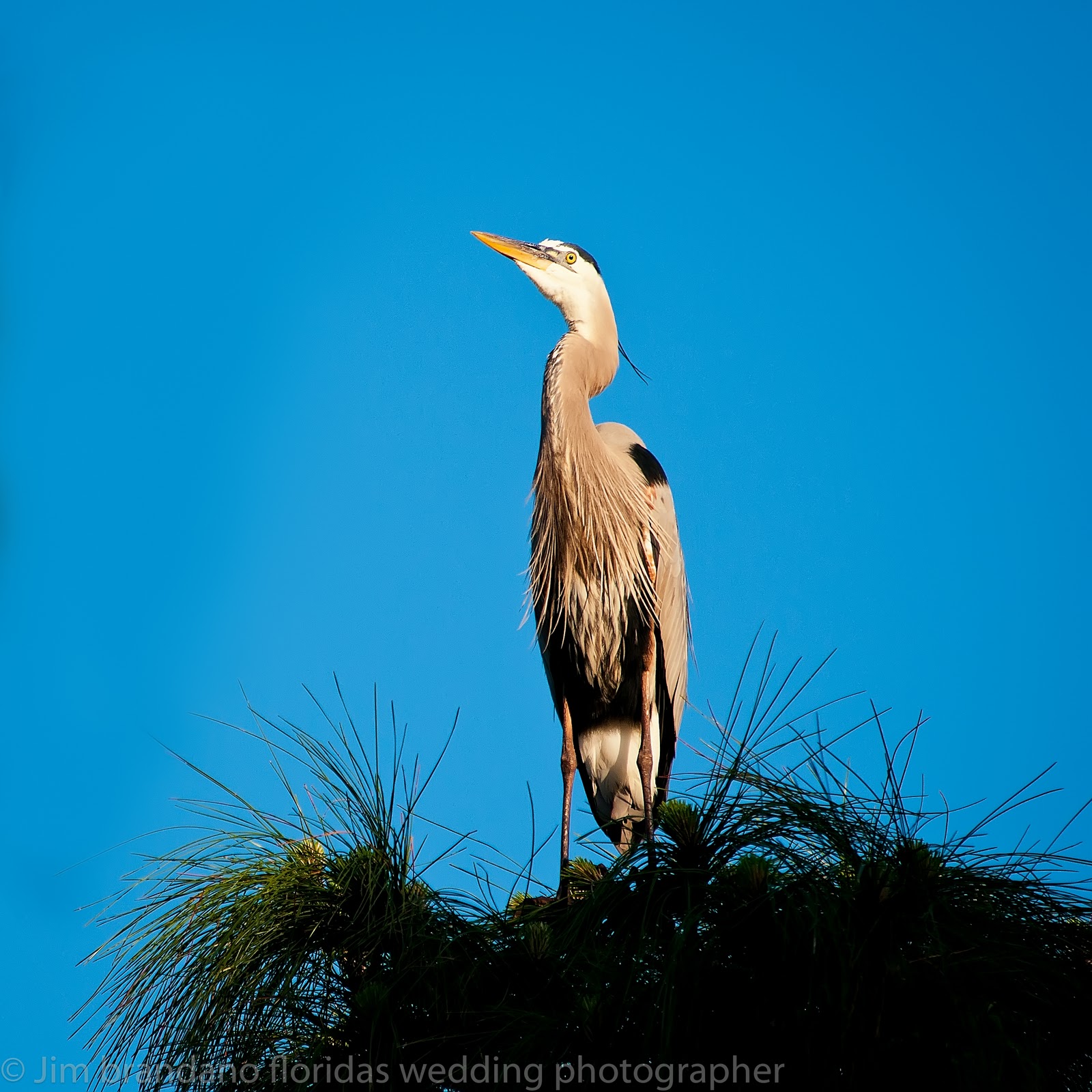
As I was approaching the pond, I saw a great blue flying into the pond area. I parked the car, took out my equipment and before I left the car looked up and saw a blue up on a treetop in the morning light.
I setup and took these images. I was pretty happy with them and I still had not reached my spot or seen the nests or chicks.
                  You can see the yellow bill and the plumage only present during mating.

                                                                  Grooming itself.

As you can see, it was grooming itself, something that both of the great blues were doing the whole time I was there and something that caused the hungry chicks to become angry. I left that spot and went around the shrubs to where I could see the nest. I could also hear the chicks because they were very loud. The first nest: these images are from the lower nest.

                                                          CHICK WAITING TO BE FED
                                                      YOU CAN SEE BOTH CHICKS


  You're probably wondering what these last two images are. Well, I told you a photographer needs patience. What do you do when the chicks lie down and you can't see them and the Great Blue has its back to you? You wait, but I also looked around and started to play. I saw the reflections and thought I would try my hand at some impressionist's paintings, my way.  I kind of like them. What about you?
Tomorrow, we have some really fun images of nest two: some really interesting behavior on both the parent and the children. See you then.
Monday, April 4, 2011

ONE OF THE REASON'S I LOVE LIVING IN FLORIDA? NATURE PHOTOGRAPHY!!!!!

As some of you know, we just moved to Port St Lucie, Florida. We live in the PGA Community. PGA stands for the Professional Golfers Association. You have just read the extent of my golfing knowledge. Well, that and apparently infidelity is great for your game...till you get caught and your wife uses a 9 iron to prove a point!!! I have never golfed and really have no burning desire to start now. I understand it is a great game and people love it. I enjoy sports and played most of them but not golf. Plus I look really awful in red plaid pants. We live in PGA because it's a great community in every way: wonderful neighbors, great facilities and nature is all around us. I have blogged about walks on my street and what can be seen. If you take a car ride about a half mile from my house, you can see some nature at its finest.
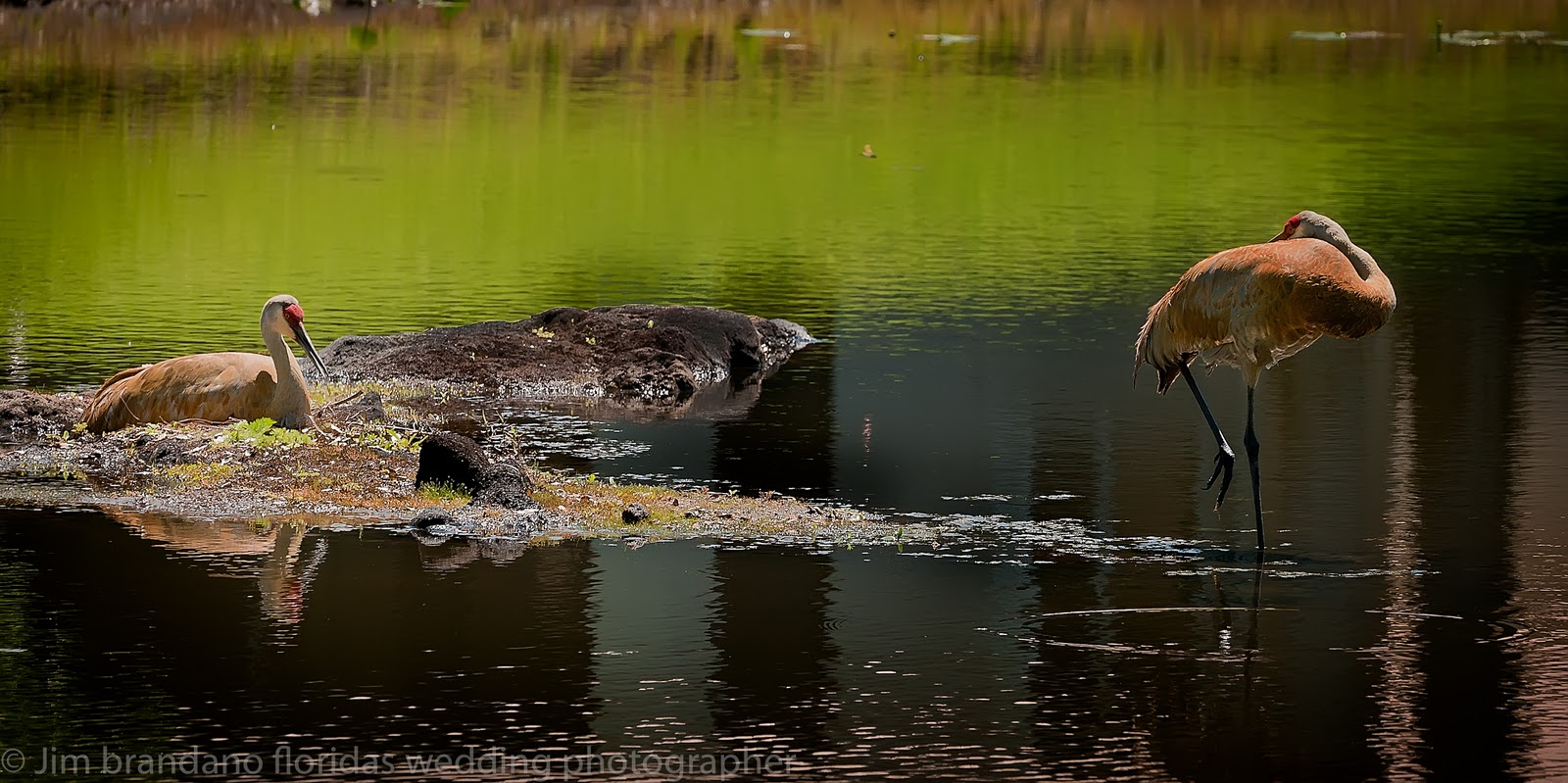
Saturday, I did just that. I took my camera, tripod and my 70-200 lens with me and started out hoping to find something interesting to photograph. After about a quarter mile,  I saw two Sandhill Cranes  standing by the side of the road. I took these images from my car as I knew they would be crossing the road and I did not have time to get out of my car and set up my tripod. This is what I captured before they decided to cross over to the other side.


Not a bad start and I continued on. There are ponds all over the community and I started slowing down looking between the shrubs and trees to try and spot something in the pond. I thought I saw something white but could not be sure if it was an egret or a stick. I pulled over and grabbing my camera walked toward the pond.

Then I saw it really was a white stick. Not exactly nature at its best! I started looking around and noticed I was not alone. There was a Great Blue Heron standing on the other side of the pond and a cormorant swimming around the pond. Both were looking for breakfast. The cormorant found its first. I heard a splash and saw the cormorant surfacing after swimming under water looking for prey. It had been a successful dive. When it surfaced, it had what looked like a catfish in its mouth.


    It swam over to the shore to enjoy his well earned meal. I went back to observing the heron.

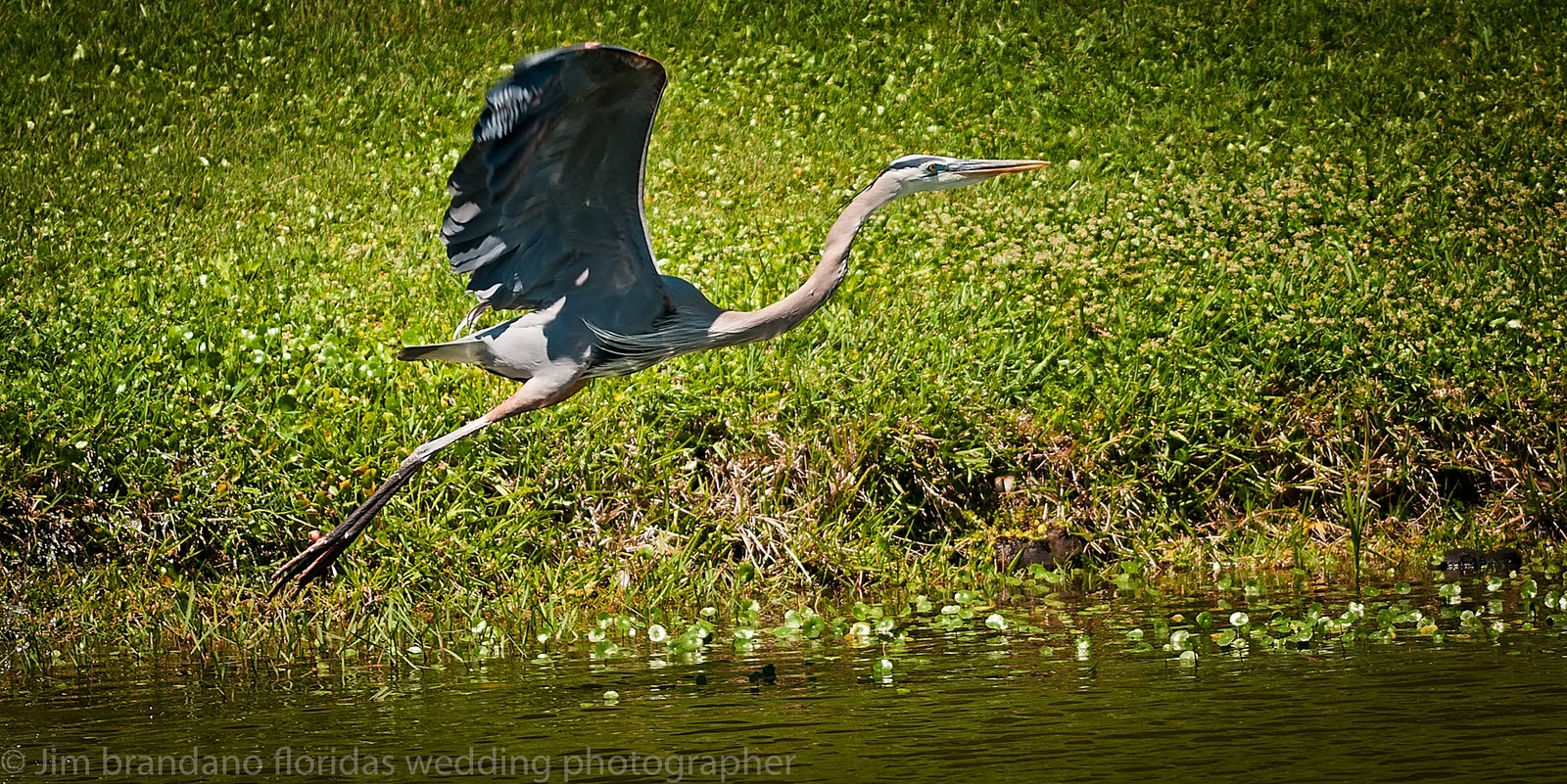
  He really was not doing much, just standing on the shore occasionally looking over in my direction. I was across the pond and it was not exhibiting any signs of distress so I knew I was far enough away from it. As I watched, it started to ruffle its feathers and bend its knees. I knew what was coming and tried to get ready for it. It took off flying low over the pond till it gathered enough speed to rise up and out of sight. I did get these two images of its takeoff and flight.


 I started to leave the pond when I looked down and saw the skeletal remains of a large bird.

   I am guessing it was either a heron, egret or crane: a reminder that nature has its own sadness.

   I left the pond walking towards my car and remembered there was another pond across the street. I  
   walked over and saw two cranes. One of them was sitting on a nest.


 I will need to keep checking on this nest and attempt to take some pictures of a newly hatched crane.
 If and when I do, you will see them on our blog.

I checked out one more pond before I headed back to the house. The sun was getting a little high in the sky so I was losing the good light but I wanted to check out one more pond.  As I was driving up to it, I saw a Great Blue flying overhead towards the pond. I parked the car and once more walked between the bushes for a look.

I love photographing nature, landscape or animals, (for the sake of this blog, I will include birds and reptiles in the animal category). People ask me if I have a favorite and I have to honestly say I don't. If I am shooting a wedding, a portrait session or a part of nature, I am happy. I love it all!!! I have also been asked what is harder, people or nature?  I really do not think one is harder but they do have their unique set of challenges. When you are photographing animals, that is really candid photography!! You have no control of where they are or what they are doing. Unless they are close enough to use a little fill flash, you also have no control of the light. I know you can move your position to put the sun in an advantageous position between you and your subject, but not always, especially when a pond separates you from that location. When you're shooting any animal out in the wild, it will invariably turn its back towards you. If you wait long enough, it might turn back toward your direction but not always.

As I approached the pond, I didn't see the Giant Blue I had seen flying. I didn't see any birds or any other animals. I thought I would wait a few minutes and looked at the pond. Both Phyllis and I have mentioned that after photographing your image, you should look around; behind you, to your left and your right. That is what I did and I saw nothing, just me and the ponds and the trees. But as I stood there, I realized one of my other senses was telling me something. I heard this noise, a chatter, I guess. I looked across the lake, nothing!! Then I looked up and into the trees and I saw them: two large Heronry which is what herons' nests are called.


The two nests were in separate trees but very close to each other, as you can see. Were there any chicks? If there were, could I see them from below? They were about 90-100 feet above me and had tree branches and limbs all around them. The best view seemed to be in the middle of the pond or across the pond on the other side, which were backyards of people's houses. I was looking to see if I could spot anyone on that side but no on was there.  Now the sun was getting really high and creating a high contrast situation. None of these conditions created a warm feeling of confidence in me.

       Did I see any chicks? If I saw them, could I actually photograph them?

Well here is a clue!! Tomorrow, I'll blog about my second day at this site and post some, what I think are  pretty interesting images. See you tomorrow for part 2 of Heron Chicks and Patience!!!!

Friday, April 1, 2011

LOVING OUR CAMERAS - by PHYLLIS

While taking images at the Red Sox game, I thought of Galen Rowell. He used to say, "When you're working in the field, turn around and look behind you. You might find a better story!" Not one to ignore an inspiration, I immediately looked around and was struck by the amount of people holding cameras. These were not necessarily professional photographers, although there were a few present. These were everyday men, women and children who were excited to be part of something and worked hard to find a way to record it.

What I liked best about seeing them was no matter what tool they used; cell phones, point and shoots or high end DSLRs, each had a relationship that was tangible. Some shooters were shouting, "Yeah, that's it, I got it!" while others cursed about a missed shot. Cameras were caressed, coddled and shaken while given words of encouragement or blame. Watching people respond to their cameras, made me reflect on relationships, in general. It was clear how much humans now invest in their machinery. The emotions we once saved for friends, family and loved ones have been transferred to our tools of convenience. Who can't sight a friend or family member who is in love with their computer or software! When was the last time you looked into the eyes of a spouse or loved one for hours on end, while playfully attending to their needs. I suppose it's our reliance on technology that makes us so committed emotionally. But I wonder if a wife, brother or friend wouldn't appreciate hearing words of encouragement and support that we delegate to inanimate objects.

Well, it's food for thought. Next time you feel like hugging your computer, go to your spouse or child instead. Cameras help us document the trip but people make the trip worth taking.