Monday, July 11, 2011

THE GRAND CANYON PART TWO

( Please remember to click on images for a larger view)
After we were shown our cabin and unpacked we started walking along the rim taking photos. As I mentioned in my first post on the Grand Canyon the view down into it seemingly changes by the minute. As the sun moves across the sky shadows form in different areas. Atmospheric haze can be seen more or less always but depending on the light it becomes more evident. Between the haze and the different locations of the sun, colors seem to change; intensifying or becoming muted.


If you're there after a rain shower the air becomes really clean and clear and the haze dissipates. On this trip there were no rain showers but the canyon is always wonderful to see. It is one of those places where you realize the enormity of the world and how small you are in it!! It's a great place to get a sense of perspective on life.


On the rim there are critters: the ones on the ground and the ones that fly.
  
The squirrels are very use to people and will take food from your hands. It is never a good idea to feed wild animals, they can become dependent on humans for food and loose their fear of us. In larger animals this can become really dangerous for humans. Also some of the food we usually have with us might not be healthy for the animals.


There are larger animals on the rim but I'd never seen any until later that night!! More about that later!


We wanted to try and photograph a sunset and one place to do that is at Mather Point. When we arrived there it was already getting crowded and we quickly staked out our place on the rim from where to shoot. I was amazed at the number of people, some with children who ventured out onto the rock outcroppings along the rim. These are natural formations and have no railings, one slip and you fall at least 450 feet on hard rock. Surviving a fall is rare. But people still feel the need to chance it. As you can see from this picture there is very little room for error. If the two people farthest out had ever slipped, stumbled or fallen they more than likely would have been dead. 


As I was standing there looking at them I heard a voice say, " That's nature's way of thinning the herd." I turned and saw a man in his 50s fully bearded wearing a cowboy hat. He was a local guide speaking to a group that was with him. He told them that at least once a year someone falls to their death. He said, "It's almost always due to their own foolishness. People don't think and up here. If you don't think you could die". He said that the year before on the same rocks a couple had taken their really young child out and didn't hold the child's hand. The child ran towards them and something happened: the child ended up falling to it's death. 


The sunset turned out not be anything great. Most people started leaving but we have been through this before. With nature nothing is guaranteed, it's not produced by Disney. We knew that sometime when the sun goes down you can still get some pretty nice images. We and a few others waited. It was not the best sunset we have ever seen but it was worth the wait.


I composed different images as the sun went down behind the mountain range. After dark we went over to the El Tovar Hotel for dinner. I think it is your best bet for a really good meal and a glass of wine (or two) on the rim. 


After dinner we went upstairs to the lounge for a few adult beverages. We were lucky because there was a small patio with one table and no one was sitting there. We spent an hour or so out in the night air relaxing and talking about our day. We knew we had an early morning and decided two martinis would do. In hindsight one might have done the trick quite nicely!! 


As we walked outside on the path to our cabin talking and laughing just enjoying the night and each other, we saw them. On the lawn in the back of the hotel were a few large plastic elks. I had my camera with me and thought it would be a fun image. Then I heard Phyllis say," Jim they're real!!" Now, why we thought that the park would put fake elk out side on the rim, I have no idea. Well, I think it had something to do with a few glasses of wine and a few martinis!! 


I have photographed elk before in Colorado and other places. I know the signs when you're getting to close to them, there are no signs!! The only ones who know how close you can get to them without triggering a negative response are the elks. They get as big as a thousand pounds and have a surprising burst of speed. I knew that you should stay about 30 yards from them. I repeat, I knew this. I had photographed them in the past but not after a few drinks. Remember my mantra..ABS (Always Be Shooting). At night after a few drinks and close to wildlife may not be the best time to ABS!!
I took a photograph from a reasonable distance, (not 30 yards).


The elk ignored me which gave me a false sense of security. I had a mid range zoom with me and decided I wanted a closer picture. Now even though I knew you don't go running up to the elk, I slowly started walking closer photographing. In the background, I remember hearing Phyllis telling me not to get too close. But I proceeded to go closer.


At this point I am about 60 feet from the elk and you can see he is eating but keeping one eye looking at me.


I am now about 50 feet from it. He is paying much more attention to me at this point.


I knew at this point I was as close as I was going to get. He was still looking at me as he ate. When he put his head down to get more grass, I really noticed how large his antlers were. I also remember thinking if he charges me, I really don't have anywhere to run, the rim was about 60 feet behind me in darkness. I started thinking I should back up and get out of there. But this time when he brought his head back up from the ground, he snorted. That's not a good thing and I remember seeing him charge at me. I still took one more images as I was backing up quickly.


You can see I clipped off the top of his rack and a hoof. At this point I wasn't thinking too much of composition. I walked really quickly back and to my right. The elk charged once more but stopped a distance from me and just looked. A false charge meant to warn me. It worked!!


He went back to eating as we walked up the path but he kept looking at me, I think daring me to come back. I thought better of it and we went back to our cabin. 


The next morning we went out early and started photographing the morning light on the canyon.


In this picture (above) you can see people (lower left) starting out on their hike down into the canyon.


This shows the early light warming up the walls of the canyon and reaching into some points in the canyon. 


The images below are of Lookout Studio. It was designed in 1914 by Mary Colter as a gift shop and lookout point. There are two good lookout points opened in good weather. You can see how well it was designed to blend into the surroundings.


This is the top of the rim in the early morning. There are not too many people up and walking around. You can see a small retaining wall and a bench carved out of trees from the canyon.


Like I had written in my earlier post, I have visited the Grand Canyon many times over the years.  Every time I visit, walk up to the rim and look down and out at this wondrous canyon, I feel the same feeling: a sense of solitude, no matter how many other people are near and a renewed respect for nature and the natural world. This is a wonderful country and world with many amazing areas. Go into it and search them out. The closer we all get to nature the more we will understand what we stand to lose if we do not try harder to co-exist with nature.


Friday, July 8, 2011

OSPREYS: UNIQUE BIRDS OF PREY


Good morning bloggers! It's Phyllis again. Today I'm sharing some of my images taken while at the Merritt Island Wildlife Refuge in east central Florida. Merritt Island Refuge has more than five hundred species of birds and fifteen federally-listed endangered or threatened species living within the marshes and uplands surrounding the Indian River and Mosquito Lagoon. It's a unique place to photograph because you can drive along the backroads and see interesting bird behaviors that you would normally not see. Many of the roads are unpaved and therefore birds feel free to wander around living their lives without fear of intruders.

Before beginning our trip, Jim and I stopped at the Visitor's Center, which I highly recommend. The staff are extremely knowledgeable and provide useful information like which areas are more likely to contain certain birds and when best to photograph them. Each visitor is provided with a booklet and map which identifies small signed areas for observation and specific information about the birds you will find. 

The refuge contains many walking trails for those who want explore the wildlife on foot. However, when you are carrying a variety of photographic equipment, it is sometime easier to travel by car. Merritt Island Refuge provides both. There are clearly designated routes for viewing by car and the most popular one is Black Point Wildlife Drive. It is important to note that many of these roads are unpaved. We drove our car through with little trouble but the tuffs of grass of each side of the path under the car scrape a bit when you drive so if your car is low, you may want to think of another vehicle.

During this trip, Jim and I traveled the dirt roads for sometime. We encountered groups of ibises, herons, egrets and Roseate spoonbills enjoying the quiet of the refuge and the communal sounds of nature. While on the path along West Gator Creek, I noticed a bird in a tree and quickly stopped. Jim knew immediately what the bird was but I needed my long lens to see it. When I brought my 80-400 lens to my eye, I was so excited....The bird was an osprey and it was eating a fish!!!

Ospreys are raptors or birds of prey. They weigh about two to four pounds and are about twenty-five inches long with a wingspan of four to six feet. The upper parts of their bodies are deep brown while the breast is white and sometimes streaked with brown while the underparts are pure white. The head is white with a dark mask across the eyes reaching to the sides of the neck. Ospreys have a short tail and long, narrow wings with four long finger-like feathers and a shorter fifth. Their bills are black and the feet are white with black talons.


Ospreys a great fish hunters but to actual see one eating was truly amazing!! I waited a short time before opening the car door to make sure I wouldn't disturb his meal. When it was clear he wasn't distracted, I took out my camera and began shooting. I stopped a few times just to enjoy the moment because I sometimes get so caught up in the shooting, that I forget to be part of the experience. This time, I made sure I did. Nature is such an important part of our lives but we often forget to appreciate its gifts. I hope you enjoy these images of the osprey while I leave you with this quote from Shakespeare in Act 4 Scene 5 of Coriolanus:

I think he'll be to Rome
As is the osprey to the fish, who takes it
By sovereignty of nature.


Thursday, July 7, 2011

THE GRAND EXPERIENCE

Although I am a Florida based photographer, I have been lucky to travel to other states and countries. I have seen the mountainous beauty of the Canadian Rockies, the free to roam wildlife in Colorado, the great vistas of Arizona, the shear wonder of the haystacks along the Oregon Coast, the diverse ecosystems of Washington State, the colorful surroundings in Nassau and Saint Martin islands, the Spanish Steps in Rome and the art and architecture of Florence, Italy. 


These all, in their own rights, are amazing sights to experience but for me, three stand out as a total awe inspiring moment when they first come into view. When you visit Seattle, you can see Mount Rainier in the distance from all over the city. As you are driving toward Rainier, it is omnipresent, always there in your sight. After you enter the park and are driving on a tree lined road, you loose sight of it for awhile. At one point the road bends and as you come around that bend it appears, looming large and truly magnificent; seemingly filling up the sky in front of you. It is snow capped, breathtaking in its enormity, with a beautiful deep blue sky surrounding it. We have visited three times and each time it is truly an amazing experience, one of those times that for a moment you don't speak you just look and enjoy nature's work. 


In Rome, at the Vatican you can take a tour and at a certain point you enter the Sistine Chapel. My eye and I think most other people's eyes are drawn to the ceiling and to Michelangelo's fresco painted circa 1511. It illustrates the biblical story from the book of Genesis in which God, the Father breathes life into Adam, the first man. God is depicted as an elderly white bearded man wrapped in a swirling cloak while Adam, on the lower left is completely naked. God's right arm is outstretched to impart the spark of life from his own finger into that of Adam, whose left arm is extended in a pose mirroring God's. 


When I looked up and saw this and realized that I was in the presence of a truly fantastic piece of both art and history dating back to the 1500s, I experienced a strange feeling, a mixture of excitement and serenity.  I stood with others our heads raised in awe of this wonderful piece of art painted by an artist who was mainly a sculptor. He stood for hours on a large scaffold with his neck bent back painting his vision, a vision that has lasted over 500 years. Whatever religious doctrine you believe or don't believe, you cannot help but be in awe the first time you see this magnificent sight.


The last of my three stand out experiences was the first in chronological order for me. In the 1970s, I moved from Massachusetts in the USA to the state of Arizona. I was not there very long when I knew I had to see the one place in Arizona you have to see if you're a photographer or not, the Grand Canyon. It was about a three hour drive back then and when we entered the park we found a line of cars traveling slowly up towards the rim. If my memory is correct it took us about an hour to reach the rim and find a parking space. We parked and I walked very quickly up to the rim and look out and into nature's work of art.
THE GRAND CANYON.

I am not sure anything has ever been named better than this canyon! What other word can best describe the experience of seeing this for the first or the one hundredth time. I am not sure how many times over the last thirty years I have visited but each time I do, I still find myself just standing and staring out into this wondrous canyon. 


The last time Phyllis and I visited was 2009. We decided to book a cabin on the rim and stay overnight. If you decide to stay at the rim, call months earlier than the date you want to stay, as you can imagine their rooms are booked months ahead. There are a few accommodations right on the rim. The two hotels are the Tovar and the Bright Angel Lodge. Another option is to rent cabins which are less then a one hundred feet from the rim. While not overly luxurious, they are really great to stay in. We stayed in a one bedroom called the Pioneer Cabin and would stay in it again, gladly. Below is the desk where you check in.

This was the cabin we stayed in for the night.

These are some of the views from about 100 feet from our cabin.


This is not an amusement park but a real life nature experience and with that comes real life responsibilities and danger. We spoke to one of the park rangers and found out that almost every year people fall to their deaths here. While the rim has a small wall running along it (maybe 3 feet high) in many areas it is a pretty shear drop to the bottom about 5000 feet below.


That past year a family was standing on an area with no retaining wall and as the mother stepped back to take a picture, she stumbled and fell over the edge to her death. A young man was showing off  and attempted to jump out to an area much like the white outcropping in the above photo. He made a great jump but a very poor landing both on the outcropping and on the floor of the canyon, falling to his death. I do not want to see anyone fall to their death but people need to take precautions and be aware of their surroundings at all times when out in nature. The star here is nature not us and nature can be very unforgiving! 

  Below is one of the buildings on the rim. This is actually a gift shop lol, you always need a gift shop!!!

 Some of the things that makes the canyon a beautiful and difficult place to photograph is the haze, changing light and the contrast that is almost always present. In my next installment, I have more images of this GRAND CANYON and my story of meeting an elk on the rim, very late at night, while walking back to our cabin after dinner and a few adult beverages.

Tuesday, July 5, 2011

COLLABORATION WITH ROY DURHAM

If I write the phrases Gone Fishing, Garage Sale or Auction and Thank You & God Bless most of you would know who I was referring to without my ever mentioning Roy's name. If you know Roy from his blog,  (http://royd-spiltmilk.blogspot.com/ ) you like him, you cannot help but like this philosopher cowboy. Much in the fashion of Will Rogers this cowboy dishes out his homespun ideas on life, the world and the people in it with just the right amount of smiles.  Just who is this man named Roy? Let me have him tell you a little about himself.


" Looking back down the trail, I have done things, seen things, experienced some things, and live my life.  Fifty four years ago I made a dollar mowing lawns and shoveling snow. Fifty years ago I repaired a radio and a TV or two.  Well! I done a few thing that cowboys do like, driving cattle it’s  the steering wheel I ‘m not sure about; I don’t remember wheels on the steers, bailing hay, sloping hogs, and feeding chickens.  Had a friend name Chris Limoux. I still ware a cowboy hat, vest and boots.  I remember ice being delivered and put in our icebox by a man driving a horse drawn wagon, the Jewel tea man, and the tinker that came to our home the same way.  If I close my eyes I can still see steam locomotives’. I have built a few houses, worked on the railroad, worked on the space shuttle, worked on star wars, not the movie,  did the development test of the air bag and if you have had the vocation to use one I hope you realize I was thinking of you. Ouch!!! I have worked in law enforcement and security. Drove a long haul heavy haul truck, laundry deliver truck, race car and my mother to gray hair."


Now tell me is this not a man you would be interested in sitting down and having a cold beer with or riding the range while he regaled you with stories about his life?? I think I would like that!


The Name of Roy's Poem is;


A LOT OF  SONG!!


To all who venture here

Take with you my joy


My spirit sings of angel wings


The notes you played


A kiss my friends

A gentle hug


My hand reaches


From my heart


A cup of his blood

To fill your soul


From me to him to you


Thank you, god bless you


Great poem Roy I hope you approve of my visual


interpretation of it....


I am looking for poems for next month so please send 


them in to me if would like to collaborate.

Friday, July 1, 2011

BIRDS: THE HEART OF THE EVERGLADES!

Hello to all our faithful readers. I'm Phyllis, Jim's other half. Today, I'm posting a blog on my trip through the Everglades National Park in Shark Valley. The Shark Valley area is home to a diverse number of animals and plants. The various species change with the seasons and water levels throughout the year. As a result, every journey through the Everglades offers a different experience for each visitor.


Shark Valley offers tram tours that last about two hours. The tour is led by a naturalist, in our case a very knowledgeable guide named Bill, who took the visitors through the northern region of the park. As Bill was identifying plants and animals that we encountered on our travels, I was snapping furiously. What I noticed most was the serene environment which allowed the birds in particular, to roost. In my photography experience, I'm used to seeing birds fly frantically to escape the peering eyes of the unwanted. In this park, they were comfortable, settled and beautiful. The first two images demonstrate that environment:
( Remember to click on an image for a large view)


As we proceeded along, I began to notice some stunning bird behavior. The first bird was an anhinga. The anhinga is a large bird with a long S-shaped neck and long pointed bill. The males have grayish-black feathers with a greenish shine to them. They have large wings with silver-white feathers on the top side. Females have a light tan head, neck and chest and a black stomach. 


Both male and females have long fan-shaped tail feathers. The anhinga has poorly developed oil glands and its feathers aren't as waterproof as other water birds so it will often perch in a tree or on the ground and open its wings to dry its feathers and warm its body. I was able to capture that behavior here.


My next encounter was that of a little blue heron. The little blue heron is a small heron. It is about two feet tall with a wingspan of about forty inches. It has slate-blue feathers with a maroon neck and head. Its bill is gray with a black tip and curves slightly downward. It has gray to blue legs and feet. Males and females look alike.


The little blue heron eats fish, crustaceans, amphibians, insects and reptiles. It stands in shallow water and waits for its prey to go by and then it grabs its prey with its pointed bill. The little blues have a lifespan of about seven years.


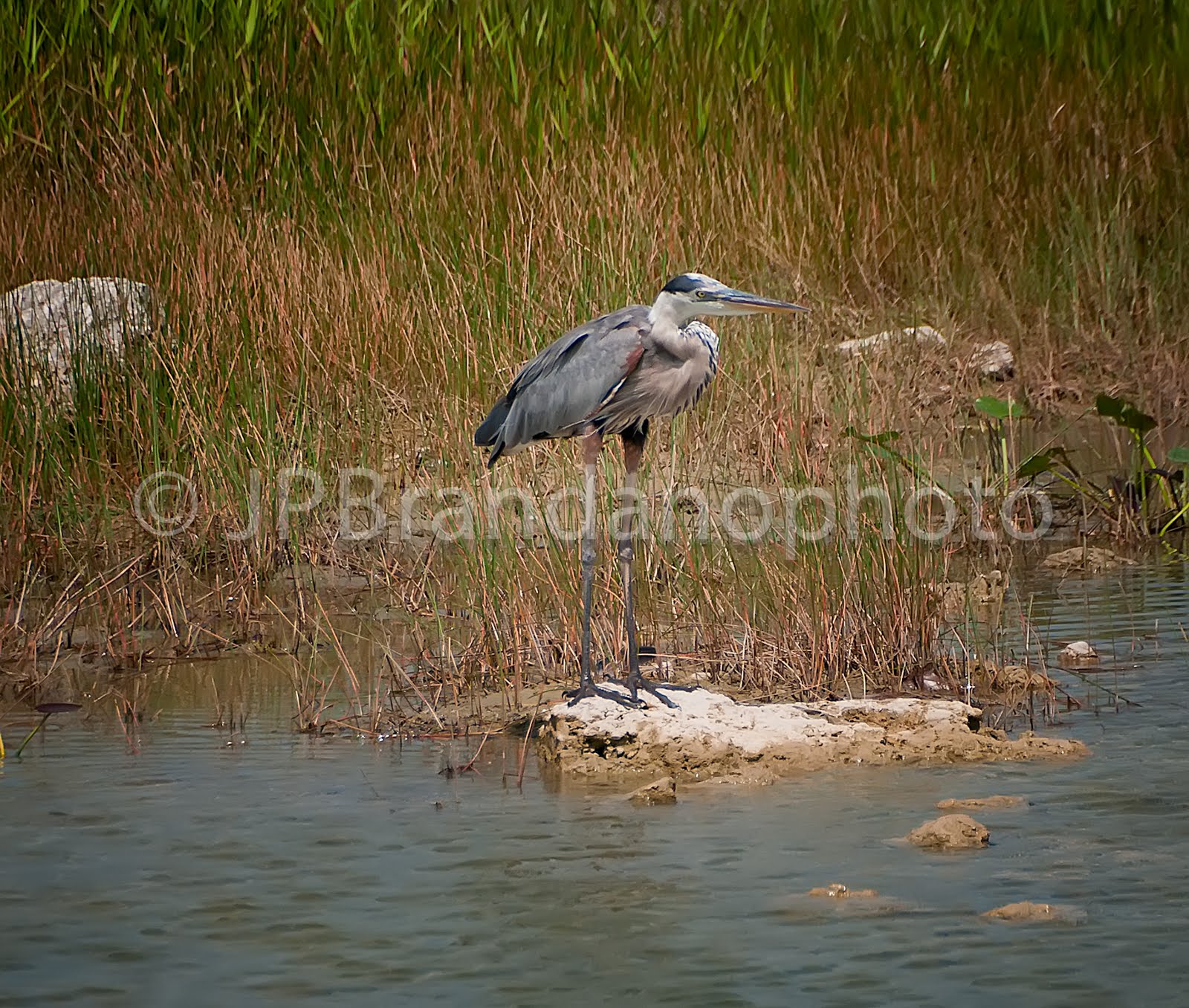
My last images are those of a Great Blue Heron. Great blues reach about four feet in height and have wingspans of about six feet. Because of hollow bones, adults weigh an average of only five pounds. They have long necks and a long bill adapted for grasping prey. 


Great blue herons are stand and wait predators. They can remain motionless for long periods of time waiting for prey to get close. 
Their large size enables them to feed on a variety of prey including fish, frogs, turtles, young birds and bird eggs, snakes, insects and other small mammals. They feed during the day or night generally within three miles of their colony. They tend to be lone feeders but if food is plentiful, they will feed with others. 


I have to admit, Great Blues are some of my favorite birds. Because of their ability to wait, I am encouraged to stare at them for hours. The amazing thing about them is because they are so acclimated to people they will not be disturbed if you watch them hunt and for that I am eternally grateful. 


I hope you have enjoyed my visit through the everglade world!